
Writing By Kester Terna
Meta Description: Learn how to get your website cited by AI search tools like ChatGPT and Perplexity with proven, ethical techniques — no shortcuts, no paid placements.
How to Get Your Website Cited by AI
Somewhere right now, someone is asking ChatGPT a question your website could answer better than anyone else on the internet — and your site isn’t in the response. Not because your content is weak, but because it isn’t structured in a way an AI model can find, trust, and quote.
That gap is becoming one of the most important problems in digital publishing. As more people ask questions directly inside AI tools instead of scrolling through search results, being citable is starting to matter as much as being rankable. The good news: getting cited by AI isn’t a black box, and it definitely isn’t something you can pay for. <cite index=”14-1″>Citations inside tools like ChatGPT and Perplexity are earned through technical setup, content structure, and authority signals — not bought</cite>.
Here’s a grounded, no-shortcuts breakdown of how it actually works.
First, Make Sure AI Crawlers Can Actually Reach Your Site
This sounds basic, but it trips up more sites than any content strategy ever could. If an AI crawler can’t access your pages, nothing else you do matters.
<cite index=”20-1″>Three layers tend to fail silently: robots rules, bot protection, and rendering — and a surprising number of sites block AI crawlers by accident, often through a blanket rule copied from a template or a security setting left over from an unrelated bot-spam incident</cite>.
A quick self-check:
- Confirm your
robots.txtfile explicitly allows the major AI crawlers rather than blocking them by default. - Make sure the facts you want cited live in plain HTML, not hidden behind JavaScript, tabs, or accordions. As one technical guide puts it, <cite index=”21-1″>the text an AI needs to cite must live in the HTML itself — AI crawlers read your site differently than a human, and content trapped behind JavaScript that never renders for a bot simply doesn’t exist to it</cite>.
- Check your server logs occasionally to confirm the crawlers you’ve allowed are actually showing up.
This is unglamorous work, but it’s the foundation everything else sits on.
Check related article: GEO vs SEO: What’s the Difference? A 2026 Guide for Marketers
Write Content That Can Be Lifted Cleanly Out of Context
AI models don’t read your page the way a human does, scrolling and absorbing tone. They extract discrete, self-contained pieces of information. That changes how you should structure a page.
Effective AI-citable content tends to share a few traits, according to multiple current guides on the topic:
- A direct answer near the top. Don’t bury your main point in paragraph six. <cite index=”17-1″>Every citation-worthy page needs a self-contained answer block near the top, along with named sources and original statistics inside the body</cite>.
- Specific numbers and named sources, not vague claims. “Significantly improved results” is unquotable; “improved results by 23% over six months” is.
- Clear, single-idea sections. <cite index=”15-1″>Organize the page so an engine can navigate it and isolate one idea at a time — clean structure is what turns a good answer into an extractable one</cite>.
This lines up with academic findings, too. Researchers behind the original GEO-bench study found that adding statistics, quotations, and cited sources to a page meaningfully increased how often it was referenced in AI-generated answers — while keyword stuffing, the classic old-school SEO tactic, actually made pages less likely to be cited on some platforms.
Add Structured Data (Schema Markup)
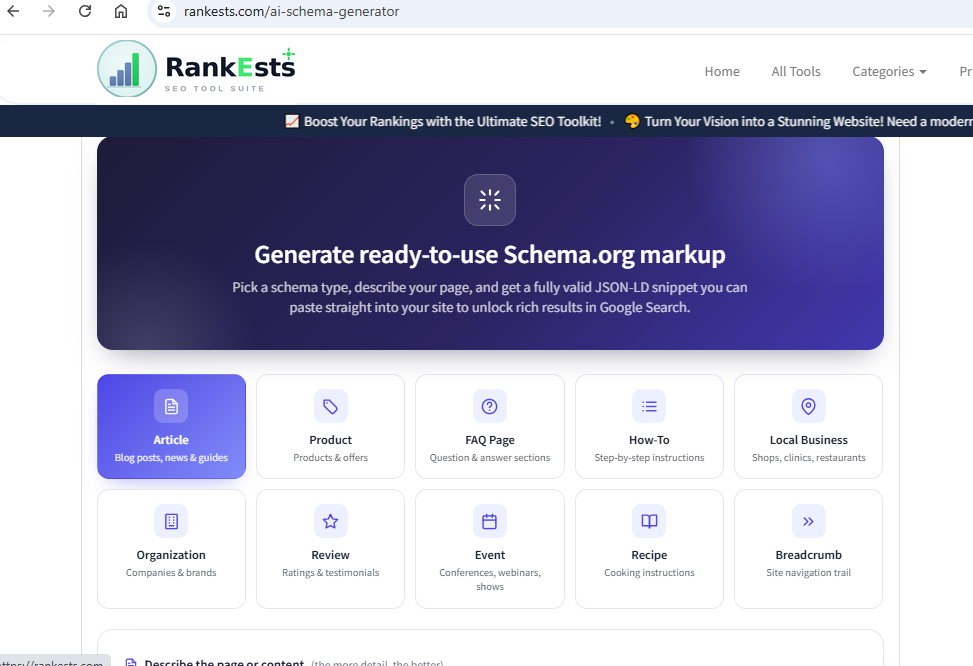
Schema markup is a standardized vocabulary that labels what your content means, not just what it says — think of it as a set of clear labels an AI model can read instantly instead of having to infer meaning from prose.
<cite index=”19-1″>The five highest-impact schema types for AI citation are Article, FAQPage, Organization, Person or Author, and HowTo, each supporting a different part of how engines understand your site’s entities and claims</cite>.
Some research adds a useful caveat worth taking seriously: <cite index=”19-1″>a large sample of Google AI Overview citations found that schema-marked pages were cited more often than unstructured pages after controlling for domain authority — but a separate analysis of hundreds of AI-cited sources found no significant standalone correlation between schema markup and citation frequency, suggesting schema amplifies existing authority rather than manufacturing it from scratch</cite>.
In plain terms: schema markup helps AI systems parse strong content correctly. It won’t rescue thin or unoriginal content on its own.
Build Real, Independent Authority Signals
This is the part most site owners underestimate, and it’s the hardest to fake. AI models weigh what the rest of the internet says about your brand — not just what your own pages claim about themselves.
<cite index=”21-1″>If five independent sources describe a business as “a leading creative studio” in its field, an AI model is far more likely to repeat that description than if the claim only appears on the business’s own website</cite>.
Signals worth building over time:
- Genuine coverage or mentions in established, reputable publications
- Consistent business information across review platforms and directories
- Being referenced by other pages that AI models already trust — since <cite index=”15-1″>engines cite sources they can identify with confidence, and being referenced by a source that is itself already cited compounds your own odds of being cited</cite>
- A clear, accurate “About” page that removes any ambiguity about who you are and what you do
None of this happens overnight, and that’s a feature, not a bug. Authority that’s earned through real coverage and consistent information is exactly the kind of signal that’s difficult for low-quality content to fake — which is also, not coincidentally, the kind of content Google AdSense and other ad networks want to see on monetized sites.
Consider an llms.txt File — With Realistic Expectations
You may have seen llms.txt mentioned as a must-have. It’s worth understanding what it actually does before investing heavily in it.
<cite index=”20-1″>No single file makes the difference on its own, and as of now no major AI operator has publicly confirmed using llms.txt in production retrieval — the confirmed levers that matter are crawl access, answer-shaped content, and sourced claims</cite>. That said, <cite index=”20-1″>an llms.txt manifest costs under an hour to create, forces a useful inventory of your most important pages, and positions your site well if adoption becomes more formal — reasonable insurance, as long as it never substitutes for the fundamentals</cite>.
Treat it as a small, low-cost addition to a strong foundation — not a shortcut around building one.
Keep Content Fresh and Accurate
Freshness matters differently across platforms, and it’s worth tailoring your approach rather than assuming one rule fits every engine. <cite index=”16-1″>Perplexity tends to value content freshness more heavily than ChatGPT, while ChatGPT leans toward encyclopedic authority and Google AI Overviews lean on existing organic search positioning — meaning an effective strategy has to diversify rather than chase a single formula</cite>.
Practically, that means:
- Adding visible “last updated” dates when you revise a page
- Refreshing statistics and examples rather than letting them go stale
- Removing or correcting claims that are no longer accurate
Corroborated, current pages consistently outperform stale ones, regardless of which AI engine is doing the citing.
Comparing the Major AI Search Platforms
| Platform | What It Tends to Reward | Typical Time to Appear |
|---|---|---|
| ChatGPT Search | Domain authority, topical relevance, encyclopedic depth | <cite index=”14-1″>Roughly 1 to 3 weeks after publishing, since it’s powered by Bing indexing</cite> |
| Perplexity | Freshness, clear factual structure, fast crawl access | <cite index=”14-1″>Often within a few days, if PerplexityBot is allowed to crawl the site</cite> |
| Google AI Overviews | Existing organic rankings, schema markup, backlinks | <cite index=”14-1″>Follows Google’s standard indexing cadence — typically 4 to 8 weeks for new or updated pages</cite> |
What Not to Do
A responsible approach to AI visibility also means avoiding tactics that damage trust — with AI systems and with readers alike:
- Don’t fabricate statistics or quotes to make content seem more “citable.” Inaccurate claims that get cited by an AI model can spread misinformation quickly, and they erode the credibility you’re trying to build.
- Don’t stuff keywords in an attempt to game relevance. It performs worse, not better, on modern AI systems, and it makes content harder for real readers to use.
- Don’t buy backlinks or reviews to manufacture authority artificially. Beyond violating most platforms’ policies, this is precisely the kind of manipulative behavior that both search engines and AI systems are increasingly good at detecting.
- Don’t hide content behind intrusive interstitials or excessive ad clutter that could make a page difficult to use — this also runs against AdSense’s own guidance on providing genuine value to visitors rather than optimizing purely for impressions.
The Final Points
Getting your website cited by AI isn’t a trick you install once. It’s closer to good, old-fashioned publishing discipline: make clear claims, back them with real sources and data, structure pages so both humans and machines can navigate them, and build genuine authority instead of manufacturing the appearance of it.
The sites earning citations right now aren’t the ones that found a clever loophole. They’re the ones that made their most useful information easy to find, easy to trust, and easy to quote — which, as it turns out, was always good advice for building an audience in the first place.
Have you noticed AI referral traffic showing up in your analytics yet? Share what you’re seeing in the comments, and if this guide helped clarify where to focus first, feel free to bookmark it and check back — this space is evolving quickly, and worth revisiting as platforms update their approach.